The Moments When the World Makes Sense on Its Own
For the ones who can’t stop explaining - and wonder what happens when they don’t.
I sometimes think we’ve trained ourselves to read the world the way we read news headlines: quickly, conclusively, always trying to make sense of things. Even in the smallest moments – a long silence in a conversation, the glance of a stranger on the train, the way a day suddenly feels heavy for no clear reason, or when someone doesn’t text back right away – we rush to interpret, to slot things into stories we already know. We call it understanding, but often it’s just a quiet refusal to sit with what doesn’t yet make sense.
I notice it in myself all the time. When something puzzles me, I instinctively start to decode it, explain it, to make it fit. Maybe it’s a habit of our culture; this belief that if we can name something, we’ve somehow mastered it. But naming is not the same as knowing. Sometimes it only builds a wall between us and what wants to be felt.
I carried that habit with me to Vietnam, without even realizing it.
I had come to Vietnam with a question that wouldn’t leave me: how do people relate to the world around them, and what might that reveal about the way I do? I didn’t want to study the answer from afar; I wanted to live it. To see how my own ways of looking – shaped by the need to understand, to explain – would meet and stumble against other ways of being.
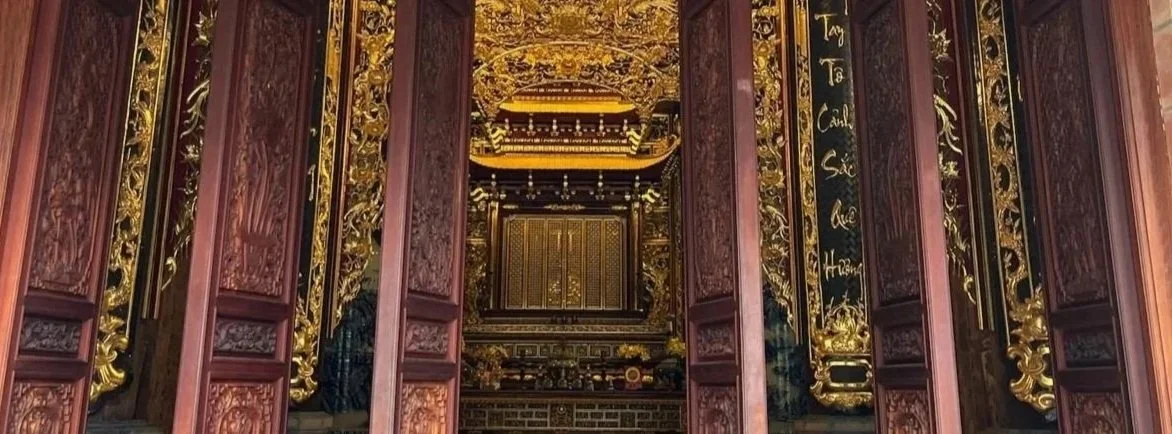
One morning, just outside Huế, I visited a pagoda. Deep sound of gongs echoed through the courtyard, bodhi trees swayed gently above me, and the stone tiles shimmered in the first light. I stood there with my notebook in hand, determined to be a diligent observer. I wrote down what I saw – the patterns of the monks’ robes, the way four women placed fruit on the altar, the colors of the paintings on the walls. Precise, factual, accurate.
But the longer I stood apart scribbling notes, the more artificial it all felt. I realized that each time I wrote something down I was already shaping the moment – deciding what counted as important, and in doing so, letting other parts of the experience slip away. The smells of the trees, the warmth of the air, the quiet pulse of devotion – none of it fit into my tidy grids of meaning. My analysis caught the details, but not the life between them.
A monk who had been watching me from the side shuffled toward me and said softly:
“You cannot understand the sound of the bell if you stand outside of it.”
I jotted that down in the margin of my notebook, not yet realizing how true it was.
Later, walking through the temple garden, I felt that sentence echo through me. Maybe that was what I had been doing all along – standing outside the sound. Trying to understand life from the outside of it. Trying to observe, categorize, and explain instead of letting myself resonate.
Philosopher Isabelle Stengers warns against what she calls the universal key: the temptation to unlock every situation with the same categories, as if meaning were a puzzle waiting for the right solution. I realized I was trying to do just that. In my training, the world had always been something to be decoded. But now, my decoding failed. It felt like a trap – an anthropological trap, as Alberto Corsín Jiménez might say – the moment when your own framework shows its limits so clearly that you feel stuck inside it. At first, it feels like failure, but in reality, it can be fertile: a crack in your lens, one that makes you start seeing differently.
A few days later, I returned - but this time, I left my notebook closed and sat quietly by the entrance. My eyes still scanned restlessly; habits don’t vanish overnight. But gradually, the rhythm of the place began to seep in.
That’s when I noticed her - a woman probably in her forties, moving slowly toward the altar. She wasn’t in a hurry; every step seemed to listen before it landed. The fabric of her long blouse brushed softly against her legs, and in the dim light it caught a faint shimmer of gold from the hanging lamps. The air thickened with incense, a warm, resinous scent that clung to her skin as if the place itself recognized her.
Unlike the tourists who passed in clusters, whispering, clicking shutters, she didn’t seem to enter the temple; she belonged to it. The moment she crossed the threshold, something in the atmosphere shifted - as if the light adjusted to her presence. Her hands rose together in front of her chest, fingers folding in a gesture that was neither practiced nor deliberate but deeply remembered. She paused, lowered her head until her hair brushed the edge of her palms, and exhaled. The movement was so quiet that even the incense smoke seemed to slow.
Her gaze didn’t rest on the statue in front of her; it turned inward, as though she was greeting something unseen. Around her, the murmurs of footsteps and distant chants seemed to fall into the same slow rhythm as her breathing.
I realized I was watching too openly. When she lifted her gaze, our eyes met. It wasn’t long - just enough for recognition to pass between us. She smiled, barely, and with a subtle shift of her weight made space beside her.
It was almost nothing, but it changed everything.
I moved closer and sat down. The coolness rose faintly through the stone into my legs, a sensation so steady it pulled me back into my body. We didn’t speak. We simply faced the same altar - she with her devotion, me with my uncertainty. I wasn’t sharing her experience, but her stillness rubbed off on me. Her pause offered permission for my own.
For a few minutes, there was no observer and no observed - only two presences resonating side by side, holding difference gently.
That morning something shifted. I had been trying to make sense of everything – the chants, the smells, the gestures – as if understanding could be reached by effort. But the harder I tried, the further it slipped away. Then, without deciding to, I stopped. I stopped trying to read the moment and simply let it be.
It wasn’t any single thing – not the sound of the gong, not the scent of incense, not even the woman’s slow movement – but the way they came together, quietly, and drew me in.
For the first time, I felt the world didn’t need me to explain it. It already made sense on its own.
Maybe you’ve felt that too. When someone you love starts to cry and you don’t search for the right words - you just sit beside them, and somehow that’s enough. Or when you’re cooking and, for a moment, everything falls into place - the smell, the warmth, the movements of your hands - and there’s nothing to fix or understand.
Those are the moments when knowing pauses to listen - when everything goes still, like air gathering before a word. That morning, it gathered me. Quietly, without asking, it changed the way I listen.
Looking back, I see that morning in Huế not as an answer, but as a beginning – a small shift in how I meet the world. It taught me that paying attention isn’t about collecting what lies outside of me, but about noticing how things move through me.
The monk’s words have stayed with me: “You cannot understand the sound of the bell if you stand outside of it”. I think about that often. Maybe understanding - the real kind - doesn’t come from stepping back, but from leaning in. From letting yourself be moved, confused, and changed by what you meet.
So the next time you find yourself trying to figure everything out - why something happened, what it means, what to do - pause. Close the notebook in your head. Notice the ground beneath you, the air around you, the presence of whoever or whatever is beside you. You don’t have to understand everything to be moved by it.
Sometimes, like in that temple in Huế, it’s enough to sit quietly next to something, or someone, and let yourself be carried by the silence you share.
A little practice:
Notice the next time something irritates you - a delay, a disagreement, a sudden change of plans. Before you interpret or fix it, pause.
Feel what’s actually there: the tension in your chest, the quickness of your breath.
What is the moment asking of you, beyond explanation?
Maybe patience, maybe nothing at all.
Or try this, with someone close to you;
When they speak, resist the urge to respond right away or to “understand.”
Listen for what’s between the words - their tone, their breath, the pauses.
What happens if you meet them with curiosity instead of certainty?